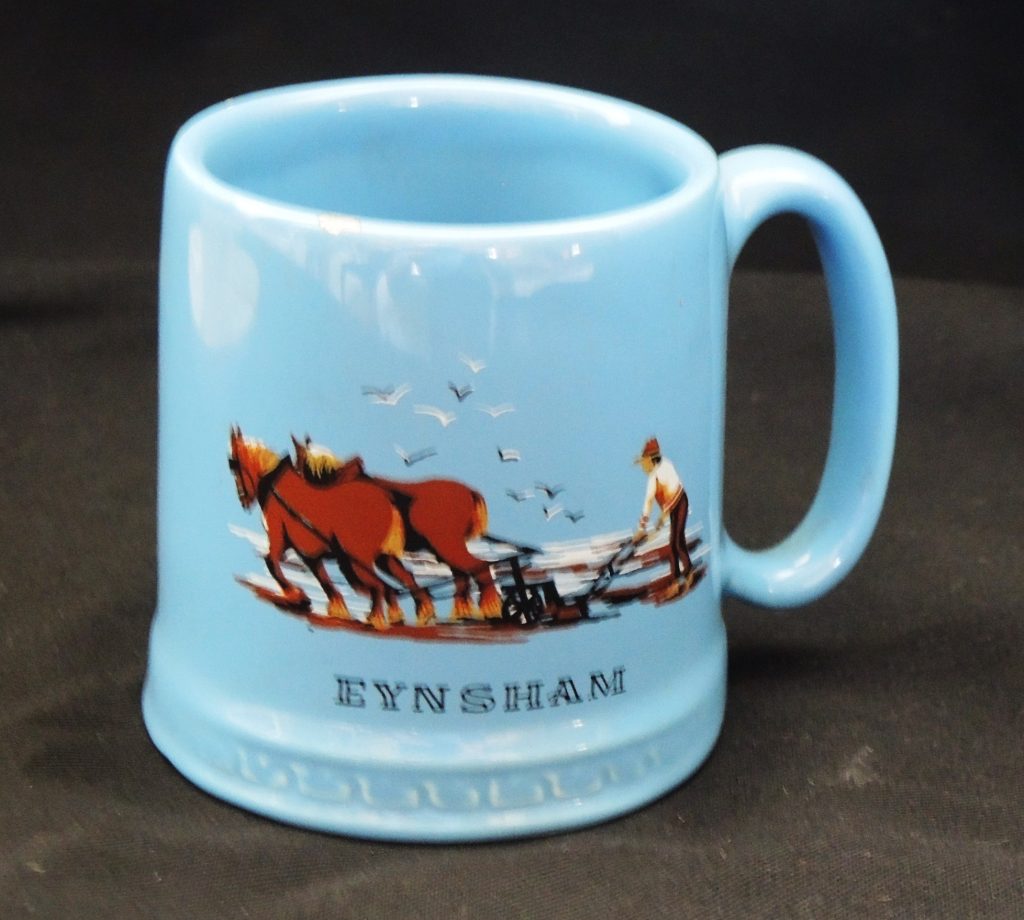
This pale blue ceramic mug, printed with a horse-drawn plough and ploughman, reflects and commemorates the rural history of Eynsham. Agriculture was a fundamental part of the life of the parish for most of Eynsham’s history. Traces of its rural heritage are still visible as you walk around. (Note: Find out more in this video, which points out the buildings in Eynsham that used to be farms.)
In medieval times, oxen were used to plough the fields. The abbot and writer Aelfric of Eynsham, in his 10th-century educational text called Colloquy, recorded something of the experience of a ploughman in Eynsham:
‘Oh I work very hard, dear lord. I go out at daybreak driving the oxen to the field, and yoke them to the plough. For the fear of my lord there is no winter so hard that I dare skive off at home. But the oxen having been yoked up, and the share and coulter fastened to the plough, I must plough a full acre or more everyday.’
Gradually, horses – especially the heavy Shire or Clydesdale breeds – took over the work of the oxen, as they were able to plough the land more quickly and easily. We know from records in the 14th century that one of the village’s farms had 12 ploughmen and 12 horses – enough for six ploughteams.
The transition away from horse-drawn ploughs began in the 20th century, with tractors gradually replacing horses during the 1930s and 1940s. During World War 2, a large barn in Bitterel was used as a central War Agricultural Depot, storing mechanical agricultural equipment, including tractors and ploughs. After the war, the final push towards mechanisation was completed. By the 1950s, farms had generally adopted machinery for working the fields. By the 1960s, horse-drawn ploughs were no longer in use at all.