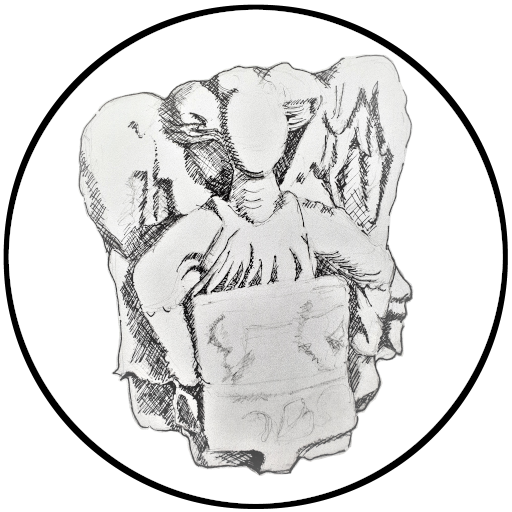
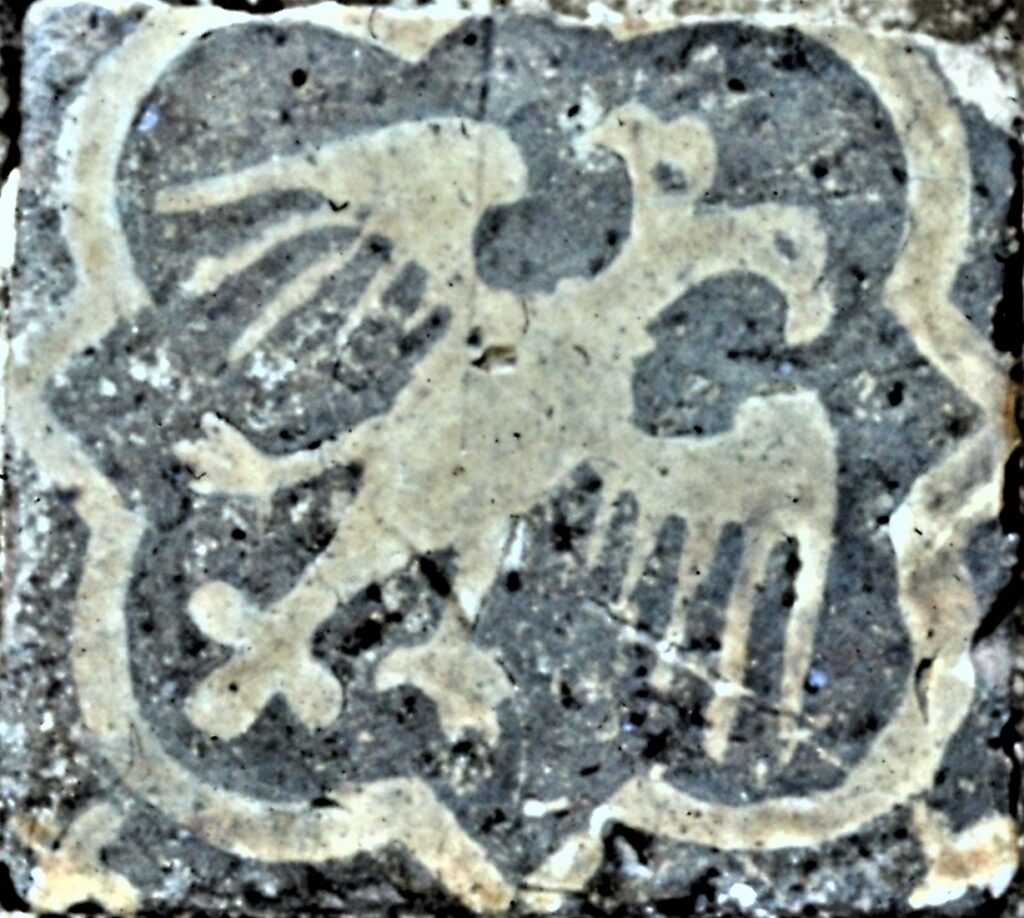
This floor tile from Eynsham Abbey, which was found in Nursery Field in the village in the 1960s, dates from around 1300 CE. It is a counter-relief tile. This means that it was created by pressing a wooden stamp (here, with the image of the eagle) into the clay in order to create an indent. The indent was then filled with white slip, which is a liquidy mixture of clay and water that can be used as a decoration on pottery.
You can see that the tile features an image of a double-headed eagle. This design was usually associated with empire. There are different theories as to why it may have been used in Eynsham Abbey.
The double-headed eagle design on the tile could be a reference to Richard, Earl of Cornwall, who was crowned King of the Romans on 27 May 1257. This title placed Richard just lower than the Holy Roman Emperor. It may have been believed, mistakenly, that Richard was a descendant of Aethelmaer, Earl of Cornwall, who was one of the founders of the Abbey in 1005.
On the other hand, the tile may be a reference to Leofric, the Saxon Earl of Mercia, who was a benefactor of the Abbey. Leofric also used a double-headed eagle as his personal emblem.
However, the same design has been used elsewhere. It was used on the floor of the Latin Chapel of St Frideswide’s Priory (now Christ Church Cathedral) in Oxford. It can also be found at Cleeve Abbey in Somerset. It is clear, therefore, that it is not an exclusively Eynsham motif.